




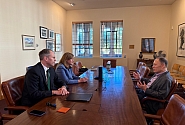
On Friday, 21 November, Zanda Kalniņa-Lukaševica, Deputy Speaker of the Saeima, met with Michael A. Keller, University Librarian at Stanford University, and Amir Weiner, Associate Professor at the University’s School of Humanities and Sciences (Department of History), to discuss opportunities for cooperation between Latvian and Californian higher education institutions, particularly in the fields of science, research, digitalisation, and artificial intelligence.
The talks placed special emphasis on cooperation with Stanford University’s Baltic Studies Program. Representatives of the university expressed interest in hosting Latvian professors and researchers, offering them the opportunity to carry out short-term research projects. They also highlighted the possibility for Stanford students to undertake internships in Latvia, which would significantly strengthen the academic ties between both sides. This cooperation will be further facilitated by the recently concluded memorandum of cooperation between the Latvian Ministry of Foreign Affairs and Stanford University.
Kalniņa-Lukaševica expressed satisfaction that Michael A, Keller and Amir Weiner have maintained close cooperation with the Museum of the Occupation of Latvia over an extended period. Cooperation with the National Library of Latvia is also being developed.
“Cooperation within specific research projects and Stanford University’s commitment to continue developing and expanding its Baltic Studies Program is inspiring. The existing contacts and collaboration with Stanford University provide an excellent foundation for further expansion,” said the Deputy Speaker.
The Hoover Institution Library and Archives at Stanford University holds an extensive collection of Latvian materials, ranging from diplomatic history and documents from the occupation period to materials on the history of the Latvian diaspora and the restoration of independence.
The Deputy Speaker also discussed with Stanford representatives the state of artificial intelligence research in the United States and Latvia, as well as current developments related to these technologies. They also discussed the upcoming Stanford “Global Seminar” to be held in Riga in the autumn of 2026, as well as the possibility for one of the university’s researchers to participate in the next International Precision Medicine Networking Forum in Riga in October 2026.
Kalniņa-Lukaševica noted: “Stanford University is one of the world leaders in science, as well as in the development of digitalisation and artificial intelligence. I see significant added value in joint projects with Latvian universities and archives—from access to Latvian historical sources held in Stanford’s archives to cooperation in the fields of artificial intelligence, data management, and life sciences. This will strengthen Latvia’s academic space, its innovation ecosystem, and the international competitiveness of our higher education institutions.”
Saeima Press Service